Glass, shower enclosures and mirrors
Glass, shower enclosures and mirrors are measured after the tiling
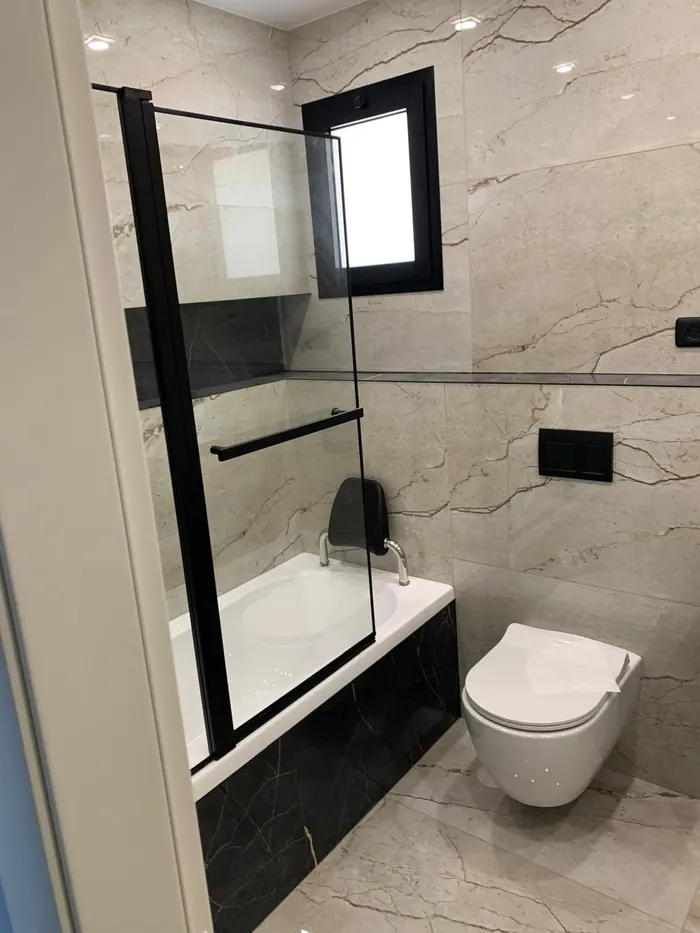
Glass work comes at the end of the renovation: shower enclosures, partitions, mirrors and glass backsplashes in the kitchen. The glass is made to measure and can't be cut down on site, so any deviation in the wall, the floor slope or the faucet location only shows up at installation. Before ordering, it is worth settling the door's opening direction, the type of hardware, the height and the glass finish. That way the measuring is done once, on the final finish.
600-28,000 ₪
by item and size
The range is a ballpark only. The final price is set after inspecting the property, the scope of work, the finishing materials and site conditions.
What's usually included?
- Precise measuring
- Made to measure
- Installing shower enclosures
- Mirrors and partitions
- Hardware and sealing
What affects the price?
- Glass type and thickness
- Dimensions and complexity
- Type of hardware
- Sealing and joints
- Access and installation location
How does RBM help keep it organized?
- Scheduling the measurement
- Verifying dimensions after tiling
- Documenting glass type and hardware
- Checking installation and sealing
Stages of the work
- 01
Planning and design decisions
Even before the flooring, you decide on the type of shower enclosure, a door or a fixed panel, and on the opening direction relative to the toilet, the sink and the towels. Agree with the plumber and the tiler on where the threshold runs and which way the slope falls toward the drain.
- 02
Wall and electrical prep
If you are planning a lit mirror or a tall partition, you need an electrical point in the right place, and sometimes reinforcement in the wall before the tiling. The contractor and the homeowners approve the location of the points before the walls are closed.
- 03
Measuring on the finished surface
After the flooring and wall tiling are finished and the grout has dried, the glass installer measures the opening and checks that the walls and floor are level. At this stage you approve the drawing, the dimensions and the type of glass before production is ordered.
- 04
Production and choosing hardware
The glass is cut, polished and tempered at the factory according to the drawing, and after that the size can no longer change. Before ordering, you choose the hardware finish, hinges, handle and seal strips, and it is worth seeing a sample, not just a photo.
- 05
Installation and sealing
Installation includes drilling for anchors, mounting the profiles or hinges, hanging the glass and adjusting the door. At the end, silicone is applied in the agreed places, and you decide together when the shower can be used for the first time.
- 06
Water test and handover
The shower is run at full flow toward the door and the panel, and you check that water doesn't escape onto the bathroom floor. The homeowners approve the seal, the door alignment and the cleanliness of the glass before the final payment.
What to check before you pay
- Make sure the measuring was done after the wall tiling and grout were finished, and that the approved drawing includes the opening direction and height.
- Check that the door opens and closes all the way without touching the sink, the toilet or the towels, and stays in place when you let go of it.
- Check that there are no chips on the glass edges, scratches on the surface or drill marks in the tiles around the anchors.
- Make sure the silicone is continuous, clean and straight along the whole line, and that there is no gap between the bottom seal strip and the threshold.
- Ask to get the type, thickness and finish of the glass in writing, along with the cleaning and maintenance instructions for the hardware.
Glass, shower enclosures and mirrors price list by line item
7 line items · updated 11/2026
Standard inline shower enclosure
1,500-4,500 ₪
per unit · By dimensions, glass type, hardware and installation.
Corner shower enclosure
2,000-6,500 ₪
per unit · Includes fitting to size, hardware and basic sealing.
Walk-in glass panel
1,800-5,500 ₪
per unit · Depends on glass thickness, height, hardware and anchoring.
Custom mirror
600-2,800 ₪
per unit · By area, edge polishing, gluing or hanging.
Lighted mirror
1,800-6,000 ₪
per unit · Includes basic electrical prep if there's a point nearby.
Glass kitchen backsplash
900-2,500 ₪
per m² · Colored or printed glass, by cuts and outlet cutouts.
Glass railing
1,200-3,500 ₪
per meter · By thickness, anchoring, required standard and access.
Updated November 2026 · price varies by spec and site conditions
See the full price listQuestions about Glass, shower enclosures and mirrors
When is a glass shower enclosure measured?
Only after the flooring and wall tiling are finished, including the grout and the corners. Every tile adds thickness and changes the opening, and measuring on a bare wall can leave a gap or glass that doesn't fit. If there is pressure to order early, do an initial measurement for planning only, and a final measurement on the finished surface. An initial measurement like that isn't enough to order production. For example, a tile thicker than planned or a corner trim added at the last minute can change the opening enough that the glass won't fit, and then it has to be reordered from the factory.
What affects the price of glass work?
The type of glass, its thickness and its finish, such as clear, frosted or printed. The hardware matters too, from hinges to profiles and stabilizer bars, and so do unusual dimensions, corners that aren't square and a floor without an elevator. When comparing quotes, make sure they all describe the same glass, the same hardware and the same installation method. Also ask whether installation, delivery and removing an existing enclosure are included in the price. Ask too whether the glass comes with a coating that makes cleaning easier, and whether the hardware resists limescale and cleaning products, because that has a big effect on how it looks over time.
Which is better, a hinged door or a fixed panel?
A fixed panel is simpler, with less hardware and fewer places that need adjusting, but it needs a wide shower and a good slope so water doesn't escape. A hinged door seals better in a small shower, and you need to make sure it has room to open. The decision depends on the size of the room and the location of the drain. It is worth asking the glass installer to mark the door line on the floor before you decide. A common mistake is a door that opens inward into a narrow shower, so whoever is inside has to step aside to open it and get out.
What happens if the wall or floor isn't straight?
It's common, and the final measurement should reveal it. The glass installer can use a profile that bridges a small deviation, or make glass shaped to fit the wall. When the deviation is large, it is worth stopping and talking to the tiler before ordering, because straight glass highlights every crooked wall. If the profile is wider than expected, ask to see it before ordering. Ask the glass installer to show you with a level where the deviation is and what solution they propose, so you understand in advance how it will look in the end and don't find out only at handover.
Can I use the shower right after installation?
It depends on the sealant, so ask the installer and get the instructions in writing. Silicone that gets wet too early can peel or leave streaks. Until then you can gently open and close the door, but don't shower or clean the glass with strong products. If streaks or spots of silicone are left on the glass, ask the installer to clean them before handover. If you did use the shower early and saw the silicone shift or come apart, don't try to fix it yourself: take photos and send them to the installer.
How do I maintain a glass shower enclosure so it stays clean?
The simplest thing is to wipe the glass with a squeegee after every shower, so limescale doesn't build up. Avoid abrasive products and rough sponges, which damage the finish and the hardware. Every so often, check that the hinges haven't loosened and that the seal strips are intact, and replace a torn strip before water starts escaping. You can ask for a spare seal strip already at installation, so it is at home when you need it. Ask the installer which cleaning products suit the hardware finish, because a painted or brushed profile can be damaged by products that are fine for the glass itself, such as an acidic limescale remover.
Related renovation work
Stone, countertops and specialty cladding
900-70,000 ₪
per meter, m² or project02Roofs and roof tiles
1,200-85,000 ₪
by roof, repair or m²03Smart home, networking and low voltage
450-45,000 ₪
by points and system04Metalwork, railings and ironwork
900-55,000 ₪
per meter or project05Accessibility and safety
1,200-90,000 ₪
by adaptation and project06Damp, mold and leak detection
150-15,000 ₪
by findings and scope of treatmentRegistered renovation contractors by city
- Jerusalem992
- Tel Aviv-Yafo487
- Rishon LeZion410
- אום אל-פחם343
- Petah Tikva315
- Be'er Sheva294
- Nazareth282
- Netanya253
- Haifa252
- Ashkelon244
- Holon244
- Ramat Gan214
- Ashdod208
- Herzliya182
- Hadera171
- Rehovot164
- Kfar Saba161
- טייבה157
- עילוט149
- מעלה עירון136
- Hod HaSharon125
- Ra'anana124
- Bnei Brak117
- מג'דל שמס107
Looking for a contractor for glass, shower enclosures and mirrors?
Build a project file with a cost range, milestones and terms, and send it to contractors who work in an organized way.
Build a project file