Stone, countertops and specialty cladding
Marble and countertops: the size is finalized against the cabinets
A marble or stone countertop is one large piece cut from a template, so it depends on everything installed before it: cabinets, walls, sink, cooktop and faucet. A mistake in a dimension or an opening only shows up when the countertop is already on the cabinets, and fixing it there is very limited. Before measuring, it is worth settling the sink and cooktop models, the edge profile and where the seams go. For stone wall cladding and stairs, the support, the finish and matching the shade between slabs matter too.
900-70,000 ₪
per meter, m² or project
The range is a ballpark only. The final price is set after inspecting the property, the scope of work, the finishing materials and site conditions.
What's usually included?
- Measuring and template
- Cutting and edge work
- Countertop installation
- Special cladding
- Sealing and finish
What affects the price?
- Stone type and fabrication
- Dimensions and scope
- Holes and special cutouts
- Coordinating with carpentry and plumbing
- Access and installation
How does RBM help keep it organized?
- Coordinating dimensions and templates
- Pulling together the spec and suppliers
- Documenting cutouts and holes
- Checking installation and finish
Stages of the work
- 01
Choosing material and finish
You choose the type of stone or countertop, the finish (polished or matte) and the edge profile, and it is worth seeing a real slab and not just a small sample. The homeowners approve the shade and the direction of the pattern, especially with natural stone, where every slab is different.
- 02
Settling the sink, cooktop and faucet
Before measuring, you need the actual sink, cooktop and faucet, or at least their spec sheets, because the openings are cut according to them. Agree with the carpenter and the plumber on the location of the sink, the drain and the supports under the countertop.
- 03
Measuring and template
Measuring is done after the cabinets are installed and leveled, sometimes with a full-size template laid on top of them. At this stage you approve where the seams go, the overhang past the cabinet fronts and all the cutouts and holes.
- 04
Cutting and fabrication at the factory
The countertop is cut and fabricated according to the template: edges, openings for the sink and cooktop, holes for the faucet and drainage grooves. If the sink model or the design changes, this is the last moment to update it, and any change is best approved in writing.
- 05
Delivery and installation
The slabs arrive on site and are brought into the apartment, so access, the elevator and the stairwell already matter at the planning stage. During installation the countertop is laid and leveled, seams are joined and an undermount sink is glued in, and the contractor and homeowners decide who connects the faucet and cooktop afterward.
- 06
Sealing, cleaning and handover
At the end, silicone is applied between the countertop and the wall and around the sink, and on natural stone a protective sealer is applied according to the supplier's instructions. The homeowners check the seams, the leveling and the finish, and approve before the final payment.
What to check before you pay
- Make sure the measuring was done after the cabinets were installed and leveled, and that the sink and cooktop that were measured are the ones that will actually be installed.
- Check with a level that the countertop is straight along its whole length, and that water spilled on it doesn't run toward the wall or the floor.
- Check that the seams are thin, the same shade and level, and that you don't feel a step when you run your hand over the joint between slabs.
- Make sure there are no cracks, chips or adhesive stains around the openings, on the edges and in the corners, and that the silicone along the wall is continuous and clean.
- Ask to get the type of material, the finish and the cleaning instructions in writing, so you know which cleaning products must not be used.
Stone, countertops and specialty cladding price list by line item
8 line items · updated 11/2026
Quartz kitchen countertop
900-2,800 ₪
per meter · Depends on model, thickness, edges, cutouts and delivery.
Granite or natural stone countertop
1,500-4,500 ₪
per meter · Material, finish, reinforcement and cutting complexity make a big difference.
Natural stone wall cladding
450-1,500 ₪
per m² · Includes basic labor; special stone or scaffolding is separate.
Marble window sills
450-1,500 ₪
per unit · By width, stone type and removing the existing sill.
Marble or stone stairs
900-2,800 ₪
per step · Depends on length, rise, finish and anchoring.
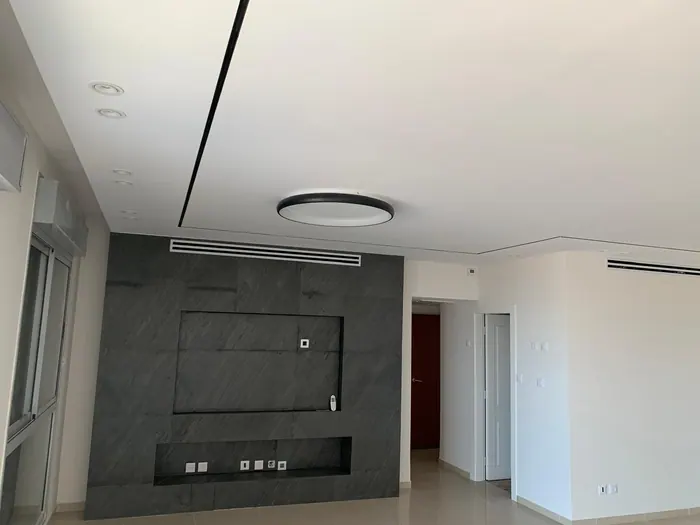
Living room feature wall
4,000-25,000 ₪
per wall · Stone, large-format porcelain, microcement or decorative panels.
Marble repair or polishing
80-250 ₪
per m² · By surface condition, cracks and stone type.
Integrated sink in a countertop
2,500-8,000 ₪
per unit · Depends on material, fabrication, delivery and installation.
Updated November 2026 · price varies by spec and site conditions
See the full price listQuestions about Stone, countertops and specialty cladding
Does the price of a stone countertop include installation?
Sometimes yes, and sometimes installation, delivery and cutouts are priced separately. Make sure the quote itemizes the material, the edges, the openings for the sink and cooktop, gluing in the sink, delivery, installation and removing an existing countertop. Without that detail it is hard to compare quotes, and extras show up right at installation time. Also ask who takes away the old countertop. For example, a cheap quote may include only the sink opening, and then every faucet hole, cooktop opening or special edge shows up as an extra on the final bill, when it is already hard to argue.
Why is a stone countertop measured after the cabinets are installed?
Because the countertop is cut to what actually stands there, not to the plan. A cabinet that shifted, a crooked wall or a corner that isn't square changes the dimensions, and a countertop cut too early may leave a gap or not fit at all. So the cabinets should be installed, leveled and secured before you order the measurement. A common mistake is measuring before the dishwasher or fridge has arrived in its niche, and then it turns out the countertop needs to be shorter or its corner doesn't fit, which can no longer be fixed with a little polishing.
What is the difference between natural stone and an engineered countertop?
Natural stone is unique in shade and pattern, but it is usually more sensitive to stains and acids and needs a protective sealer. An engineered countertop is more uniform and easier to maintain, but every material has its own limits, for example with direct heat. It is worth asking the supplier what the specific material doesn't handle well, and choosing based on how you use your kitchen. Also ask how the material behaves at the edges and corners, because that is where chips appear first, and whether you can see a kitchen where a family is already using it.
What happens if the countertop arrives with a defect or breaks during installation?
The slab is checked before it is glued down, while it can still be refused. A defect that turns up is documented in photos and recorded, and the quote should state who is responsible for breakage during delivery and installation. Don't approve a defective countertop hoping it will work out later, because after gluing, replacing it is much more complicated. A slab that arrives in a different shade from the approved sample is a reason to stop and look into it. It is also worth checking the slab in natural light near a window, because a fine crack or a difference in shade isn't always visible in the dim light of a stairwell or storeroom.
What decisions need to be made before cladding a wall in stone?
You choose the material and the size of the slabs, and decide how the pattern continues from slab to slab and where the seams go. The wall has to carry the weight and sometimes needs reinforcement, so it is worth consulting a professional before ordering. It is also important to settle in advance the electrical and lighting points that run through the wall. For example, large slabs for a living room on a high floor may not fit in the elevator, so check the route into the apartment before choosing the slab size, even if that means another seam in the wall.
How do I take care of a stone countertop over time?
Wipe up acidic liquids such as lemon juice, wine and vinegar right away, and use a gentle cleaner suited to the type of stone. Don't cut directly on the countertop, and don't put a hot pot on it without a trivet. With natural stone, ask the supplier when to reapply the protective sealer, and keep the instructions you were given. A stain that won't come out is best shown to the supplier before trying strong products. It is also important not to stand or sit on the edge of the countertop, especially near the sink opening, because the stone is narrow there and cracks more easily.
Related renovation work
Roofs and roof tiles
1,200-85,000 ₪
by roof, repair or m²02Smart home, networking and low voltage
450-45,000 ₪
by points and system03Metalwork, railings and ironwork
900-55,000 ₪
per meter or project04Accessibility and safety
1,200-90,000 ₪
by adaptation and project05Damp, mold and leak detection
150-15,000 ₪
by findings and scope of treatment06Office and commercial renovation
900-6,000 ₪
per m², by type of businessRegistered renovation contractors by city
- Jerusalem992
- Tel Aviv-Yafo487
- Rishon LeZion410
- אום אל-פחם343
- Petah Tikva315
- Be'er Sheva294
- Nazareth282
- Netanya253
- Haifa252
- Ashkelon244
- Holon244
- Ramat Gan214
- Ashdod208
- Herzliya182
- Hadera171
- Rehovot164
- Kfar Saba161
- טייבה157
- עילוט149
- מעלה עירון136
- Hod HaSharon125
- Ra'anana124
- Bnei Brak117
- מג'דל שמס107

Looking for a contractor for stone, countertops and specialty cladding?
Build a project file with a cost range, milestones and terms, and send it to contractors who work in an organized way.
Build a project file