Plumbing
Plumbing where you know where the pipes run
Plumbing in a renovation is first of all a question of scope: a spot repair, adding water and drain points, or replacing pipes all the way back to the manifold and the water heater. Most of the pipes disappear inside the walls and the floor, so a mistake in the location of a point, the drain slope or a connection only shows up after the tiling is already on top of it. Before starting, settle the location of the sanitaryware, the type of pipe and how pressure will be tested before closing up, so no one discovers the problem through a stain on the neighbors' ceiling.
350-25,000 ₪
by water points and scope of infrastructure
The range is a ballpark only. The final price is set after inspecting the property, the scope of work, the finishing materials and site conditions.
How much does a plumber cost in 2026?
In 2026, a plumber visit costs 250-400 ₪, including VAT, and the work is priced per point or item: a new water point 1,200-1,800 ₪, a drain point 800-1,600 ₪, toilet installation 500-1,000 ₪ and a concealed cistern 2,000-3,200 ₪. Fixing a hidden leak costs 1,200-3,000 ₪, and replacing all the water pipes in an apartment 8,000-25,000 ₪. Chiseling into walls, locating the leak and expensive materials move the price.
Worked examples
| Job | Range |
|---|---|
| Replacing the kitchen faucet and sinkFaucet installation + Sink installation | 750-1,650 ₪ |
| Switching from a standard toilet to a concealed cisternConcealed cistern | 2,000-3,200 ₪ |
| Replacing a solar water heaterSolar water heater replacement | 3,500-6,500 ₪ |
| Replacing all the water pipes in the apartmentFull apartment water pipe replacement | 8,000-25,000 ₪ |
Where the figures come from: every range here is a line item in the RBM Contractors price list (version 2026.11, including VAT), and every example is a sum of line items times a quantity. The price list was checked against prices published in Israel on 14 November 2026. This is an estimate, not a quote.
What's usually included?
- Water points
- Replacing pipes
- Connecting sanitaryware
- Tests and drainage
- Coordinating with flooring and waterproofing
What affects the price?
- Type of pipes
- Number of points
- Access to walls and floor
- Existing or new wet room
- Coordinating with other tradespeople
How does RBM help keep it organized?
- Survey of existing points
- Marking new points
- Tests before closing up
- Keeping photos and documents
Stages of the work
- 01
Survey of the current condition
The plumber checks the existing pipes, the main valve, the manifold and the drain lines, and marks what's old and what can stay. Together you decide whether to replace a full line or only what gets opened up during the renovation.
- 02
Marking points and heights
The location of every water and drain point is marked on the walls according to the chosen fixtures: sink, toilet, shower and washing machine. The homeowner approves the heights and distances based on the dimensions of the products they're buying.
- 03
Chiseling and laying pipes
Channels are chiseled in the walls and floor, hot and cold water pipes are laid, and drain pipes are laid with a slope toward the sewer. If the route has to go somewhere other than planned, the contractor presents the change and the homeowner approves it before it's done.
- 04
Pressure test and documentation
Before closing up, the water pipes are pressure tested and the drains are flow tested, and all the routes are photographed with measurements from a wall or corner. The homeowner receives the photos and confirms the test passed before anything is closed.
- 05
Closing up and coordinating with waterproofing
The chiseled channels are closed and the area is handed over for waterproofing and flooring, with the plumber leaving a cap on every point. This is where you agree on who is responsible for the pipe penetrations through the waterproofing layer and how they're sealed.
- 06
Installing fixtures and connections
After tiling, the sinks, faucets, toilets and shower are installed, and the traps and shutoff valves are connected. Finally the water is turned on and each connection is checked separately, and the homeowner signs off on the work only when there are no leaks or drips.
What to check before you pay
- Ask to see a photo of the pressure test with the pressure gauge, and photos of all the pipe routes before the wall is closed.
- Run every faucet on hot and cold, and check that the pressure is good and the hot water arrives without a long wait.
- Fill a sink and a bathtub to the top and release the water all at once, and make sure it drains quickly with no gurgling or smell.
- Look with a flashlight under the sinks and behind the toilet, and check for drips or damp patches at the connections and shutoff valves.
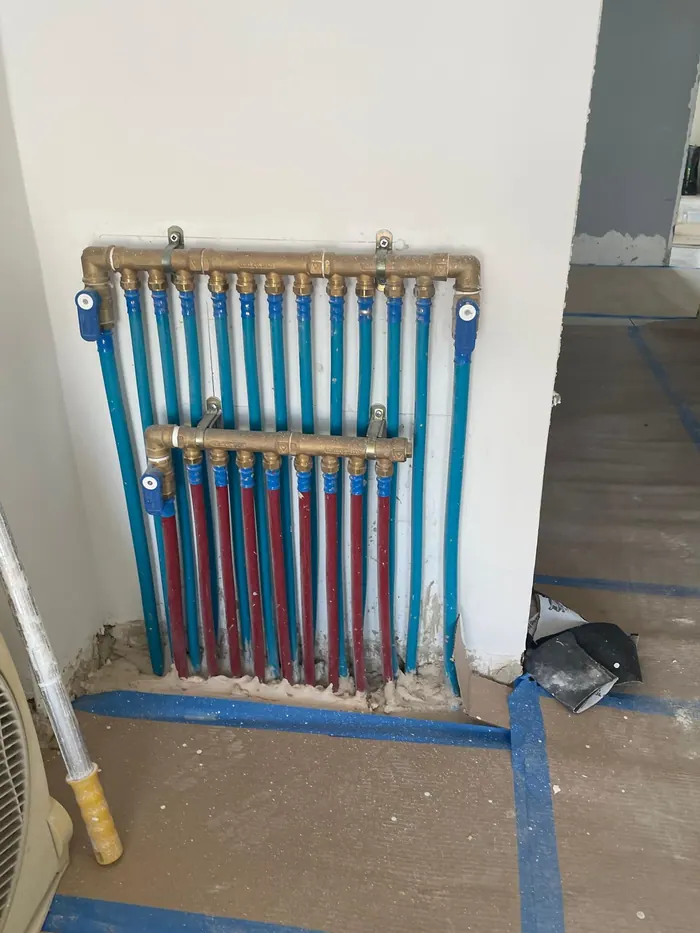
- Make sure you know where the main valve and the manifold are, and that each outlet on the manifold is labeled with the room it supplies.
Plumbing price list by line item
13 line items · updated 11/2026
Plumber visit
250-400 ₪
per visit · During regular working hours, excluding repairs.
Water point installation
1,200-1,800 ₪
per point · With easy access, without complex chiseling.
Drain point
800-1,600 ₪
per point · Depends on diameter, slope and sewer connection.
Water manifold
1,800-2,800 ₪
per unit · Usually up to 8 outlets, per spec.
Faucet installation
350-800 ₪
per unit · Excludes the faucet itself.
Sink installation
400-850 ₪
per unit · Includes a basic trap, excludes the sink.
Toilet installation
500-1,000 ₪
per unit · Excludes the toilet and cistern.
Concealed cistern
2,000-3,200 ₪
per unit · Excludes the toilet, tiling or finishing work.
Hidden leak repair
1,200-3,000 ₪
per repair · Includes basic opening and closing, no painting or tiling.
Bathtub installation
4,000-6,000 ₪
per unit · Includes a basic hookup; excludes a high-end tub.
Full apartment water pipe replacement
8,000-25,000 ₪
per apartment · Depends on apartment size, number of wet rooms and access; finishing repairs are separate.
Solar water heater replacement
3,500-6,500 ₪
per unit · Includes the tank, collector and standard installation on an accessible roof.
Electric water heater replacement
1,600-3,200 ₪
per unit · Includes a standard heater and installation; removing the old one depends on the provider.
Updated November 2026 · price varies by spec and site conditions
See the full price listQuestions about Plumbing
Why is it important to photograph infrastructure before it's closed up?
Because after tiling you can't see where the pipes run, and someone drilling to hang a shelf or cabinet could hit them. Photos with measurements from a wall or corner save unnecessary opening up when there's a leak or when you want to change something later. Keep them together with the plan of the points somewhere easy to find. A good photo shows both the pipe and a reference point such as a corner or an outlet. A good example is the shower wall, where the hot and cold lines run at exactly the height where it's convenient to hang a shelf.
Is every plumber right for a large renovation?
Not always. Someone who specializes in repairs and clearing blockages isn't necessarily used to planning pipes for a whole wet room and working in coordination with waterproofing, flooring and electrical. In a large renovation, ask about similar jobs they've done, how they test pressure and how they document the routes. Detailed answers tell you a lot about how they work. It's also a good idea to ask them to explain who coordinates the tiler and the waterproofing installer with them, because many mistakes happen exactly at the handoff between tradespeople.
Should you replace all the pipes in an old apartment?
It depends on the condition of the pipes and the scope of the renovation. If you're opening walls and floors in the wet rooms anyway, replacing them at the same stage saves opening up again in the future. If the pipes are in reasonable condition and the renovation is limited, a partial replacement can be enough. Ask the plumber to explain what they saw, not just give a general recommendation. For example, if you replace only the pipes in the bathroom and leave an old line feeding it from the manifold, rust or low pressure from the old line will keep reaching the new faucets too. So it's important to understand where the boundary between new and old runs.
What do you buy yourself and what does the plumber bring?
Usually the homeowner chooses and buys the sanitaryware and faucets, and the plumber brings pipes, connectors and working materials. It's important to agree on this in writing and to give the plumber the product dimensions before the points are marked. A product that arrives late or in a different size may mean moving a point. It's also worth asking who is responsible for removing and reinstalling existing fixtures. A common example is a concealed cistern: its frame has to be chosen and installed before closing up, even if the toilet itself only arrives at the end.
What happens when an old leak is found during the work?
First, stop and find the source, because an old leak can leave moisture in the wall or floor even after the repair. The contractor should show you what was found, propose a solution and price the extra before doing it. Before closing up, make sure the area has dried and the problem doesn't come back. Keep the photos of what was found and of the repair together with the rest of the documentation. Sometimes it turns out the leak is coming from the neighbors' apartment or from a shared building line, and then it's worth involving the building committee before deciding who handles it and who pays.
What should you keep after the plumbing is done?
Keep the photos of the pipes before closing up, the plan of the points and the details of the fixtures and faucets that were installed. Know where the main valve and the shutoff valves are, and check now and then that there's no dripping under the sinks. That way, if something goes wrong, the next plumber will know where to start. It's also worth writing down the plumber's name and contact details. For example, if a damp patch appears on a wall, the photos will show right away whether a pipe runs there and save opening up a large area of tiling to look for it.
Related renovation work
Electrical work
250-65,000 ₪
by points, panel and scope of prep02Waterproofing
120-450 ₪
per m², common jobs03Kitchen
35,000-180,000 ₪
per kitchen renovation, including related work04Doors and windows
1,500-40,000 ₪
by item and size05Carpentry and interiors
3,500-70,000 ₪
by item and custom carpentry06Air conditioning
1,500-85,000 ₪
by installation and systemRegistered renovation contractors by city
- Jerusalem992
- Tel Aviv-Yafo487
- Rishon LeZion410
- אום אל-פחם343
- Petah Tikva315
- Be'er Sheva294
- Nazareth282
- Netanya253
- Haifa252
- Ashkelon244
- Holon244
- Ramat Gan214
- Ashdod208
- Herzliya182
- Hadera171
- Rehovot164
- Kfar Saba161
- טייבה157
- עילוט149
- מעלה עירון136
- Hod HaSharon125
- Ra'anana124
- Bnei Brak117
- מג'דל שמס107
Looking for a contractor for plumbing?
Build a project file with a cost range, milestones and terms, and send it to contractors who work in an organized way.
Build a project file